
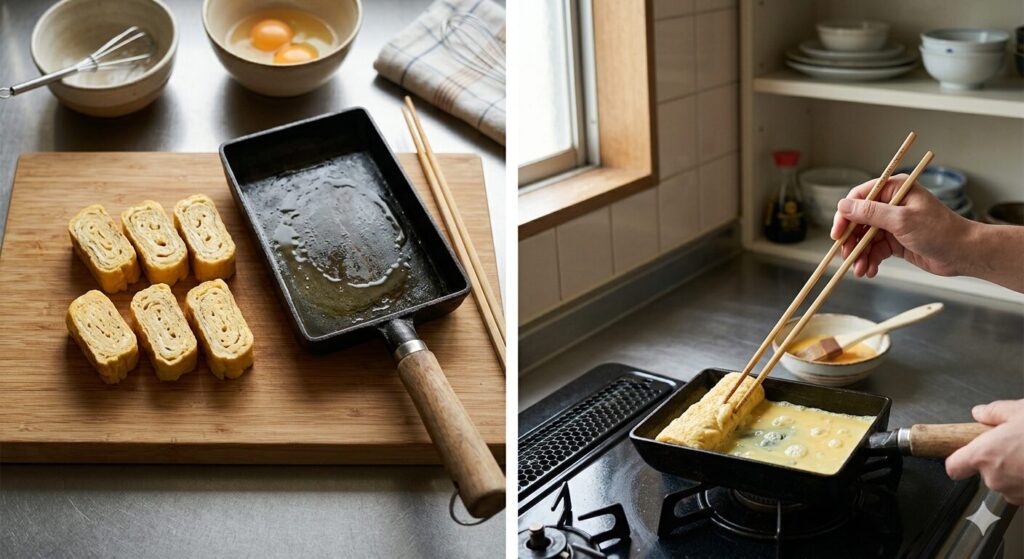
The best Japanese tamagoyaki pan for most home cooks is the Iwachu cast-iron egg pan from Morioka: it holds heat evenly, lasts for decades, and turns out a thick, layered tamagoyaki with almost no fuss once it is seasoned. A tamagoyaki pan is the small rectangular frying pan Japanese cooks use to make tamagoyaki — the rolled, layered omelette served at breakfast and tucked into nearly every bento box — and the right one genuinely changes how the eggs behave.
I am Natsuki, and I cook from a small kitchen in Yokohama. I came to good tools the slow, stubborn way. I trained in ceramics, so I am the kind of person who once simmered a iekei ramen broth for eight hours because I refused to accept a shortcut, and who broke more than a few of my own glazed bowls learning where the clay wanted to be thin. One of those failures was a soup bowl I made too shallow to actually hold soup — useful, in the end, as a lesson that the shape of a tool decides what it can do. A tamagoyaki pan is exactly that lesson in metal: the rectangle is not decoration, it is what lets you fold egg into clean layers. Below are the five pans I would actually recommend, tested against real weekday breakfasts.
What is a tamagoyaki pan?
A tamagoyaki pan is a rectangular or square frying pan, usually 13–18 cm long, designed to cook the rolled Japanese omelette in even, foldable layers. The straight edges let you pour thin sheets of seasoned egg, roll each one toward you, and build a firm block — something a round pan simply cannot do neatly.
Two shapes exist for a reason. Kanto-style pans (around Tokyo) are square, because the omelette is folded in half; Kansai-style pans (around Osaka) are longer rectangles, because the egg is folded in thirds. Neither is “better” — the shape simply matches the regional folding technique. For a first pan, a rectangular Kansai-style pan around 13×18 cm is the most forgiving.
The 5 best Japanese tamagoyaki pans
The five pans below cover every realistic need, from a once-in-a-lifetime cast-iron heirloom to a wipe-clean nonstick pan for busy mornings. All are made in Japan, and I have noted exactly which heat sources each one works on, because that is the detail most guides get wrong.
1. Iwachu cast-iron tamagoyaki pan — best overall
This is the pan I reach for first. The Iwachu egg pan is nambu tekki (南部鉄器, the cast ironware of Morioka in Iwate Prefecture), a craft tradition that goes back roughly 400 years. At about 1,175 g it is heavy, and that mass is the whole point: the iron stores heat, so the eggs cook evenly and stay fluffy instead of catching in the thin spots. The internal cooking surface is about 18×15 cm, the wooden handle is removable for cleaning, and it works on gas and IH alike.
It needs seasoning before the first use and a quick oiling after each wash, but in return it lasts a lifetime — the kind of object my ceramics teacher would have called “a tool you grow into.” If you buy one pan and never replace it, buy this.
Price: around ¥4,000–5,500. Heat: gas and IH.
Check the Iwachu cast-iron pan →
2. Nakamura Doki copper tamagoyaki pan — best for flavour
If you want the tamagoyaki you get at a good Tokyo sushi counter, the answer is copper, and Nakamura Doki is the maker professionals trust. The workshop has hand-made copper pans in Adachi, Tokyo, for four generations. Copper conducts heat faster and more evenly than any other metal, so the egg sets gently and tastes, to my palate, noticeably more tender — reviewers describe it as mellow. The 12×16 cm size handles two to three eggs, right for one or two people.
The honest caveat: this is a gas-only pan (no IH), the tin lining needs careful, gentle handling, and it costs more than the others. It is a tool for someone who already loves making tamagoyaki and wants to go deeper, not a first pan.
Price: around ¥8,000–10,000. Heat: gas only — not IH-compatible.
Check the Nakamura copper pan →
3. River Light Kiwame iron pan — best iron pan for beginners
If cast iron feels intimidating, this is the gentler way into real iron. River Light’s Kiwame Japan (極JAPAN) line is made from nitrided iron, a surface treatment that makes the pan far more rust-resistant than traditional iron and ready to use almost straight away. It is lighter than the Iwachu, works on IH and gas, and several owners say it was their first iron pan and easy to live with. The small size is built for everyday tamagoyaki and bento portions.
You still oil it after washing, but the rust-resistance removes most of the anxiety. This is what I would hand a friend who wants to “upgrade from nonstick” without committing to cast iron.
Price: around ¥3,000–3,500. Heat: gas and IH.
Check the River Light iron pan →
4. Wahei Freiz “Atta” nonstick pan — easiest to use
For the cook who just wants tamagoyaki on a Tuesday morning without ceremony, this is the right pan. The Wahei Freiz Atta is a 13×18 cm aluminium pan with a diamond-coat nonstick surface: it needs no seasoning, releases the egg cleanly, wipes clean in seconds, and works on IH and gas. It is also the cheapest pan on this list by a wide margin.
The trade-off is lifespan — nonstick coatings wear out over a few years, so think of this as a reliable workhorse rather than an heirloom. For most beginners, that is exactly the right first pan.
Price: around ¥2,000–2,500. Heat: gas and IH.
Check the Wahei Freiz nonstick pan →
5. Wahei Freiz Tsubame-Sanjo black-steel mini pan — best for bento
If you mostly make one egg at a time for a lunchbox, a tiny pan is far more practical than a full-size one. This 9×14 cm black-steel pan is forged in Tsubame-Sanjo (the famous metalworking region in Niigata), comes ready to use without pre-seasoning, and has a wooden handle that stays cool. Owners repeatedly call it a good “first iron pan” and use it daily for bento tamagoyaki.
Black steel develops a natural nonstick patina over time, like cast iron but lighter and quicker to heat. For single-portion mornings it is the most charming option here.
Price: around ¥3,000–3,500. Heat: gas and IH.
Check the Tsubame-Sanjo mini pan →
How to choose a Japanese tamagoyaki pan by material
Choose your tamagoyaki pan by material first, because the metal decides almost everything about how it cooks and how much care it needs. Cast iron and copper hold heat better than nonstick, which is why most professional breakfast cooks and sushi chefs prefer them — but they ask for more attention in return.
| Material | Best for | Care | IH? |
|---|---|---|---|
| Cast iron (nambu tekki) | A lifetime pan, even heat | Season, oil after use | Yes |
| Copper | The tenderest egg, pro results | Gentle, tin-lined | No |
| Nitrided / black steel | Beginners wanting real iron | Light oiling | Yes |
| Nonstick aluminium | Busy mornings, lowest price | Just wipe clean | Yes |
Then check two things: your cooktop, and your portion size. If you cook on induction, skip copper entirely. If you usually make one or two eggs, a 9–15 cm pan is plenty; a 13×18 cm pan suits a family.
How to season and care for an iron tamagoyaki pan
To season a new iron or cast-iron tamagoyaki pan, heat it over medium heat until it just begins to smoke, add a generous amount of oil, swirl to coat the whole surface, then wipe out the excess — this is called abura-narashi (oil conditioning). Before cooking each batch of eggs, heat the pan well, oil it, and the egg will release cleanly.
After cooking, wash with hot water and a soft brush — no harsh detergent — dry it on the burner until the water evaporates, and rub a thin film of oil over the surface to prevent rust. Done consistently, the pan builds its own slick patina and gets better every month. Nonstick pans, by contrast, need none of this: a soft sponge and mild soap are all they ever want.
Frequently asked questions
What is the best Japanese tamagoyaki pan for beginners?
For absolute beginners, the Wahei Freiz Atta nonstick pan is the easiest, because it needs no seasoning and releases egg cleanly. If you want to start with real iron, the River Light Kiwame nitrided-iron pan is rust-resistant and forgiving.
Is a copper tamagoyaki pan worth it?
A copper pan is worth it if you cook tamagoyaki often and use a gas stove, because copper’s fast, even heat produces the tender, professional-style omelette served at sushi counters. It is not worth it for induction cooktops or occasional cooks, since copper is gas-only and needs careful handling.
Can you use a tamagoyaki pan on an induction (IH) cooktop?
Most cast-iron, nitrided-iron, and nonstick tamagoyaki pans work on IH cooktops, but copper pans do not. Always check the product listing for “IH” compatibility before buying — of the pans here, only the Nakamura copper pan is gas-only.
What size tamagoyaki pan should I buy?
For one or two eggs or bento portions, choose a pan around 9–15 cm; for family servings of three or more eggs, choose a 13×18 cm pan. A smaller pan is easier to control while you learn the rolling motion.
How do you stop egg sticking to a tamagoyaki pan?
Heat the pan thoroughly before adding oil, then oil it generously before each layer of egg — a cold or under-oiled iron pan is the main reason egg sticks. With nonstick pans, simply use medium heat and a little oil; never use metal utensils, which scratch the coating.
The bottom line
If you want one tamagoyaki pan that will outlast everything else in your kitchen, buy the Iwachu cast-iron pan — it is the best Japanese egg pan for most people, and the closest thing to a permanent decision. If you cook on induction and want zero fuss, the Wahei Freiz nonstick pan does the job for a fraction of the price. And if, like me, you enjoy the slow craft of getting a tool exactly right, the Nakamura copper pan is the one you grow toward. Whichever you choose, the rectangle is doing the work — trust the shape, and the layers will follow.