
Introduction
The best instant ramen bowl holds around 900ml — enough for one pack of noodles, the soup, and your toppings without a single spill over the rim. That number matters more than the design, and I learned it the hard way after buying a beautiful bowl that turned out to be useless.
I live in Yokohama, and instant ramen is my weekday lunch almost every day. Not occasionally — genuinely almost every day, eaten at my desk between meetings. So the bowl I pour it into gets more use than anything else in my kitchen. This guide covers what actually works for a single serving of instant noodles, based on the ones I’ve bought, broken, and replaced.
Why Bowl Size Matters More Than You’d Think
A standard pack of Japanese instant ramen needs roughly 500ml of water, and once you add noodles and toppings, you’re looking at 800ml of volume minimum. Most Western soup bowls hold 400 to 600ml, which is where the trouble starts.
For years I used a cheap donburi (a deep Japanese bowl used for rice and noodle dishes) from Nitori. It worked, technically, but my noodles went cold embarrassingly fast, and I’d find myself rushing through lunch just to finish while it was still warm.
The worse mistake came later. I bought a bowl on Amazon purely because it looked good in the photos — wide, shallow, elegant. When I poured a pack of instant ramen into it, the noodles and toppings spilled straight over the sides. It was completely unusable for the one thing I’d bought it for. That bowl now holds fruit.
Then, while clearing out my mother’s kitchen cupboards, I found some old Arita-yaki (Arita ware, a fine porcelain from Saga Prefecture) bowls she hadn’t touched in years. Picking one up, the weight genuinely surprised me. It felt like a different category of object entirely from what I’d been using. That’s when I started paying attention to what I ate from.
What to Look For in an Instant Ramen Bowl
Prioritise capacity first, then heat retention, then durability — design last. That order sounds unromantic, but it’s what stops you from buying something you can’t actually use.
Capacity: aim for 900ml
Look for 800ml to 1 litre. Marusan Kondo, a Mino ware maker in Gifu, sells a bowl marketed specifically as an instant-noodle bowl, and they settled on 900ml — a useful benchmark from a manufacturer that designed for exactly this purpose. Anything under 700ml will have you eating carefully to avoid spills.
Material and heat retention
Ceramic and porcelain hold heat noticeably longer than resin or thin metal. After switching from my old Nitori bowl to Mino-yaki (Mino ware, a versatile pottery tradition from Gifu Prefecture), the difference in how long my soup stayed hot was obvious within a week. Resin bowls have their own advantage — they don’t shatter — but they won’t keep your broth warm the way fired clay does. Pick based on which problem you have.
Durability and storage
Check for microwave and dishwasher marks, and be sceptical of them. I owned a bowl labelled dishwasher-safe whose glaze started peeling after a handful of cycles. Storage matters too: in my narrow Yokohama kitchen I’ve broken two ceramic bowls simply by knocking them while reaching past. If your cupboard is tight, a stackable or shatter-resistant option isn’t a compromise — it’s the correct choice.
Design
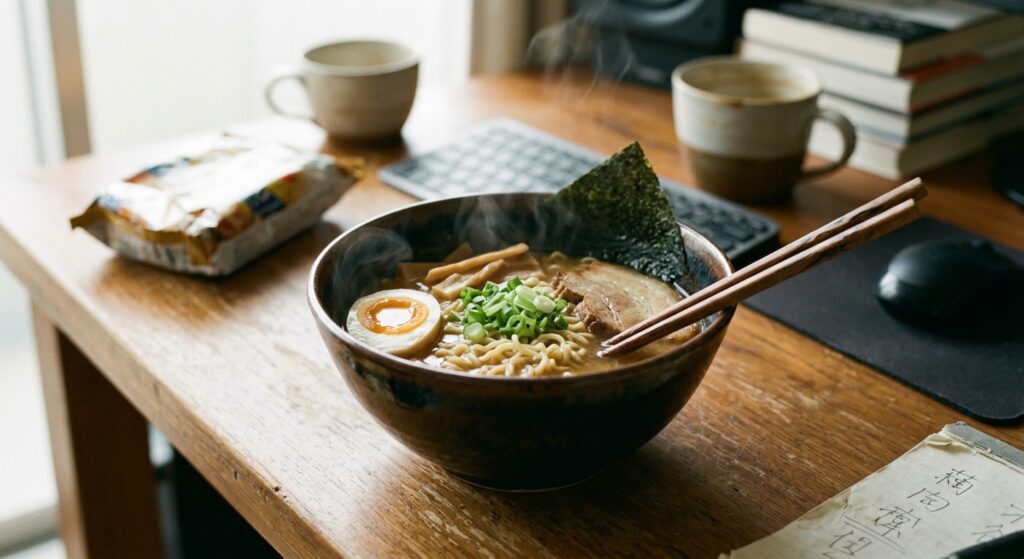
This is the part that turns a rushed desk lunch into something you look forward to. I spend weekends visiting old kissaten (traditional Japanese coffee shops) around Motomachi in Yokohama, and part of what makes those places feel good is that the vessels match the room. The same logic works at a desk. A bowl you like looking at changes a five-minute lunch.
My Picks
All five are bowls I’d actually use for instant noodles, listed with the trade-offs I’d want to know before buying.
1. Marusan Kondo Instant-Ramen Donburi L (black crystal glaze, 900ml)
This is the most purpose-built option here. Marusan Kondo designed it around a single pack of instant noodles, and at 17cm across and 9.5cm deep it holds 900ml without being wide enough to dominate a desk. The black crystal glaze looks considerably more expensive than it is. It’s microwave and dishwasher safe, and the narrow profile stacks well — which for me, with two broken bowls behind me, matters. The one caution: on a dark glossy glaze, small chips show clearly.
Check the price of the Marusan Kondo Instant-Ramen Donburi L on Amazon
2. Mino Ware Ramen Bowl (tetsu-aka iron red, 19.5cm)
A wider, more traditional shape at 19.5cm across and 7.2cm deep, in tetsu-aka (iron red), a deep rust-toned glaze. The extra width makes it easier to eat from with chopsticks and a spoon at the same time, and the ceramic body holds heat well. Microwave and dishwasher safe, made in Japan. The trade-off is the colour — it’s a strong, saturated red that will either anchor your table or clash with everything else on it.
Check the price of this Mino ware ramen bowl on Amazon
3. Pearl Metal Ramen Bowl AZ-5608 (light grey)
The practical choice. It’s lightweight resin with an antibacterial coating, shatter-resistant, and microwave and dishwasher safe. If you eat at a desk, live somewhere with limited storage, or have ever swept up a broken bowl, this removes that entire category of problem. Be clear-eyed about the trade-off though: resin does not retain heat the way porcelain does, and it doesn’t feel like ceramic in the hand. You’re buying resilience, not warmth.
Check the price of the Pearl Metal AZ-5608 on Amazon
4. Mino Ware Shikisai Multi-Purpose Donburi (kohiki white)
The most flexible of the five. Kohiki is a white slip glaze with a soft, slightly matte finish, and the shape works equally well for noodles, rice bowls, or a substantial salad. If you’re furnishing a small kitchen and want one bowl that does several jobs, this is it. Worth knowing: pale glazes pick up staining from strongly coloured broths — a miso or spicy tonkotsu soup left sitting will leave a mark, so rinse it soon after eating.
Check the price of the Mino ware Shikisai donburi on Amazon
5. Mino Ware Ramen Bowl 6.5 (aka-yu hama-kuro, professional grade)
This is restaurant-grade stock — the kind of bowl actual ramen shops buy. It’s heavier and more robust than the others, with the solid feel and heat retention you notice at a proper iekei shop (the rich pork-and-soy ramen style that originated in Yokohama). Microwave and dishwasher safe. The reason it’s last on this list rather than first: that professional build means real weight, which is more bowl than some people want for a Tuesday cup of noodles at their desk.
Check the price of this professional-grade Mino ware bowl on Amazon
My Experience
My weekday lunch is almost always instant — usually Nissin’s Men-zukuri or Cup Noodle, eaten at my desk. There’s a small twinge of guilt about it, but the satisfaction of a hot meal in four minutes outweighs it, and I’ve stopped pretending otherwise. The same goes for the rest of my weekday eating: frozen meals from Nichirei or Maruha Nichiro carry me through busy stretches, and their fried rice is genuinely better than what I’d make myself on a Wednesday night.
Weekends are the opposite. I spend them on iekei ramen shops around Yokohama — Yoshimuraya, Sugitaya — and I don’t mind the queue at all; standing in line is part of it. I once tried to reproduce that broth at home, simmering pork bones for eight hours. The result was thin and flat, nothing like the shops. Eight hours for a soup I poured away. It gave me a lot of respect for what those places do daily.
That contrast is exactly why the bowl matters to me. The weekend ramen already feels like an occasion. The weekday cup of noodles doesn’t, unless something makes it feel that way — and the vessel is the cheapest available lever. If you’re building out the rest of the table, I’ve also written about choosing donburi bowls for rice dishes and small mamezara plates for side dishes and toppings.
choosing donburi bowls for rice dishes and small mamezara plates for side dishes and toppings.
One last thing I’ve learned as a buyer here: I once bought a bowl advertised as Nihonsei (made in Japan), and found on closer research that manufacturing had actually happened overseas. Living in Japan doesn’t exempt you from checking. It just means you know which questions to ask.
FAQ
How big should a bowl be for one pack of instant ramen?
Around 900ml is the reliable answer. A standard pack needs about 500ml of water, and noodles plus toppings push the total past 800ml. Marusan Kondo, which makes a bowl specifically for instant noodles, uses 900ml — a good benchmark to shop against.
Is ceramic or resin better for instant ramen?
Ceramic holds heat significantly longer, so your soup stays hot to the last mouthful. Resin won’t shatter, which matters in a small kitchen or if you eat at a desk. I use ceramic at home and would recommend resin to anyone who has broken a bowl in the last year.
What is the difference between Mino ware and Arita ware?
Mino-yaki comes from Gifu Prefecture and covers an enormous range of styles and glazes, which is why so much everyday Japanese tableware is Mino ware. Arita-yaki is porcelain from Saga Prefecture, finer and more translucent, historically associated with detailed hand-painted decoration. For daily instant ramen, Mino ware is the practical pick.
Are Japanese ceramic bowls really dishwasher safe?
Many are, but verify the specific product rather than assuming. I owned a bowl marked dishwasher-safe whose glaze began peeling after a few cycles. Established makers state care instructions clearly; vague listings are a warning sign.
Can I buy these bowls outside Japan?
The products here are listed on Amazon’s Japanese site, and international shipping varies by seller — some ship abroad, some don’t. Check the delivery options for your country before ordering, and factor shipping into the price when comparing against locally available bowls.
Final Thoughts
For a single serving of instant ramen, buy a 900ml bowl in ceramic if you want your soup hot, or resin if you want it to survive your cupboard. The Marusan Kondo donburi is the one I’d recommend first, because it was designed for precisely this and the size is right without any guesswork.
Instant ramen is not a special meal. That’s the point. Spending a little on the bowl is the least effortful way I’ve found to make an ordinary Tuesday lunch feel like something rather than nothing.